
Wildflower of the Year 2026: Ghost Pipes (Monotropa uniflora)
VNPS offers Ghost Pipes artwork on T-Shirts and other apparel. Visit our Online Store to order.
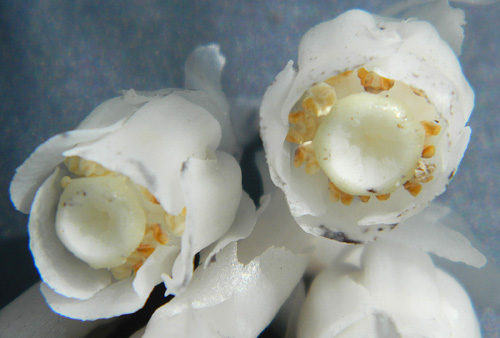
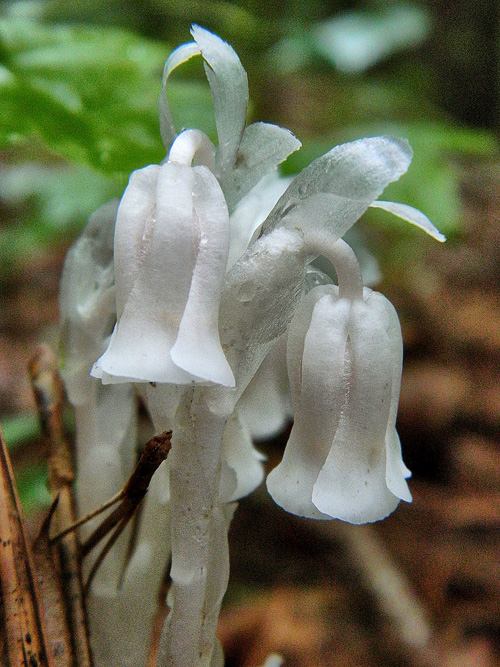
Ghost Pipes are herbaceous perennial plants that lack chlorophyll; they obtain their nutrients via mycotrophy, i.e., by parasitizing the fungi present in their roots. The plants are commonly white at flowering but, in rare instances, may be pink or red. The stems are hairless, smooth, waxy, and range from 5 to 30 cm in height, though most commonly found in the shorter portion of that range. Leaves are alternate and reduced to narrow scales pressed against the stems. Flowers are produced from June to October. Flowers are terminal, solitary, and nodding. The calyx consists of 2 to 5 scale-like bracts of unequal size, ranging 7 to 10 mm long and 4 to 6 mm wide. The five petals are separate, somewhat sac-like at their attachment to the receptacle gradually becoming wider toward their broadly rounded tips; petal dimensions range from 10 to 20 mm long and 5 to 15 mm wide. Stamens number 8 to 10 and are nearly equal to or shorter than petals; filaments are hairy; anthers are relatively short, irregularly globular, oriented horizontally within the flower, and open via a single horizontal slit (not via pores); pollen grains are shed singly (not in groups of four). A ring-like, lobed, nectary is present between filaments and the base of the ovary. Ovaries are superior and consist of four or five fused carpels, each of which bears numerous small ovules on an axile placenta; styles are short and cylindrical, topped with disk-like stigmas. After pollination, as fruits develop, flowers gradually reorient to a vertical position as the stems and leaves darken; eventually, fruit-bearing plants become nearly black. Fruits mature between August and November. Fruit capsules bear 4 or 5 vertical grooves and release numerous small seeds, 0.5 to 1 mm long, usually with a small, membranous, wing.
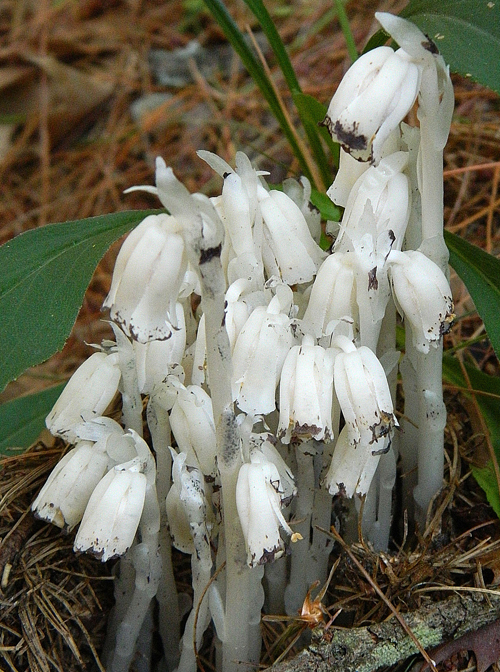
In the Garden
Because of its mycotrophic/mycoparasitic nature, Monotropa uniflora is difficult to impossible to cultivate in a garden setting. The plants require well-established networks that fungi form with forest trees, the human management of which is beyond the realm of contemporary horticulture. Nursery propagated plants are not available. If Ghost Pipes should happen to appear spontaneously in one’s garden they should be revered and enjoyed in situ.
Name & Relationships
The genus name, Monotropa, is based on two Greek words, monos, one, and tropos, turn, in reference to the sharply curved stem apex that accounts for the downward orientation of the
single flower. The species portion of the binomial, uniflora, is Latin for one-flowered. The combination Monotropa uniflora was published by Linnaeus in his monumental work, Species Plantarum, in 1753. Currently, Ghost Pipes are classified in the large family Ericaceae that includes familiar plants such as Rhododendrons, Azaleas, Mountain Laurels, and Blueberries, and a host of others. Within Ericaceae, Monotropa is closely related to two other mycoparasitic plants found in Virginia, Hypopitys monotropa (Pinesap), and Monotropsis odorata (Sweet Pinesap). Populations in northern Florida with reddish pigmentation and small differences in flower structure are accepted by some botanists as a separate species, Monotropa brittonii, the Scrub or Southern Ghost Pipe.
In the Wild
Ghost Pipes occur in mesic to dry upland forests, in a variety of soils and vegetation types. Presence of conifers and/or Fagaceae family (Chestnuts, Beech, Oaks) have been noted as common elements in their habitat, presumably because these trees harbor the fungal symbionts that Ghost Pipes require for nutrition. Long-tongued Bumblebees are important pollinators. Wind disperses Ghost Pipes’ small, lightweight seeds; staying aloft in turbulent air is likely assisted by its thin, membrane-like, seed “wings.”
Human Uses
Native Americans employed Ghost Pipes for a variety of sedative and pain-relieving effects. Presence of deleterious grayanotoxins and the circumstance that some plants accumulate toxic levels of heavy metals argue against herbal medicinal use of Ghost Pipes. VNPS makes no recommendations concerning self-medication with Ghost Pipes.
Conservation Status
Conservation status of Monotropa uniflora is secure.
Where to See It
Monotropa uniflora has a multicontinental distribution. In North America north of Mexico, Ghost Pipes occur from Nova Scotia to British Columbia, south to northernmost California in the west, and from Minnesota to eastern Texas and Florida in the east. A disjunct population occurs in cool mountainous regions of southern Mexico, and through Central America to Colombia. Ghost Pipes are also found widely in southern and eastern Asia. Ghost pipes can be found throughout forested regions of Virginia.
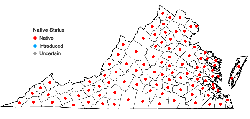
Ghost Pipes Distribution – Digital Atlas of the Virginia Flora
Text and all photos by W. John Hayden, VNPS Botany Chair
View or Download the Ghost Pipes 2026 Wildflower of the Year Brochure
Gardeners should not collect Ghost Pipes in the wild. We strongly encourage individuals to source their native plant material from a reputable nursery or seed vendor. To learn more about interesting species of plants native to Virginia, visit https://vnps.org for times and dates of programs and wildflower walks in your area, and for sources of nursery propagated plants.
VNPS offers Ghost Pipes artwork on T-Shirts and other apparel. Visit our Online Store to order.

Great information on monotropa .
I love walking through the woods and finding a small patch of these charming ghost pipes .
Thank you !
Where is the T-shirt you had designed for the ghost pipes I would love to purchase it
VNPS offers Ghost Pipes artwork on T-Shirts and other apparel: https://www.bonfire.com/store/vnps/
Will ghost pipes regrow if inadvertently destroyed? We have ghost pipes all over our property in Northern Virginia. We are concerned that upcoming landscaping work and other activities will harm or kill some of these plants.
The evidence for graynotoxins has been debunked by spectrometry conducted by university of Pennsylvania and further study is currently being conducted on the plant. That said, harvesting is strongly discouraged.
I just saw some on my property. How awesome they are you can’t miss them!!