
Grass-leaved Blazing Star, Liatris pilosa
By Betsy Washington, Northern Neck Native Plant Society
Liatris is a beloved genus of herbaceous wildflowers known as Blazing Stars or Gayfeathers in the family Asteraceae (Asters). These lovely wildflowers occur in prairies, open meadows, along open woodland edges and roadsides and are loved for the tall, slender spikes of feathery purple florets that are unique in that the flowers bloom gradually from top downward along the spike. Not only are they stunning in the wild or in our gardens, but they are one of the most notable pollinator plants, attracting over 50 species of specialist bees, butterflies, skippers, moths and hummingbirds and a diversity of other beneficial insects. All are indigenous to North America. Virginia has seven species of Liatris.
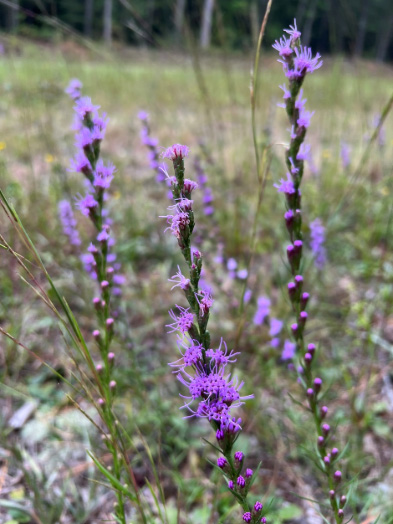
Lovely spikes of purple flowers light up roadsides; photo: Anne Parker
One of my all-time favorites is the Grass-leaved or Shaggy Blazing Star, Liatris pilosa, which occurs primarily in the Coastal Plain and lower elevations of the Piedmont. Beginning in September and extending through October, Grass-leaved Blazing Star lights up open areas with dry and nutrient poor soils such as along roadsides. It is especially abundant in sites maintained by periodic fires or under power lines that are cut regularly to maintain their open habitat and where soils have not been repeatedly plowed or disturbed.
Sadly, this lovely perennial is not widely available in the nursery trade, but seeds can occasionally be purchased and are well worth the effort to grow.
The erect showy spikes of flower heads densely line upright spikes or racemes from late summer through fall on 1 – 3’ tall slender upright stems with 10 to many flower heads directly attached to the stems (sessile) or on short stalks (pedicels). Each flower head consists of 7 – 10 small tubular pinkish-purple florets or disc florets, each with 5 rounded lobes, blooming for weeks providing long-lasting color. Unlike some aster members, they do not have ray flowers like sunflowers and daisies. Nonetheless, the colorful spikes create a dramatic show in groups or masses as they usually grow.
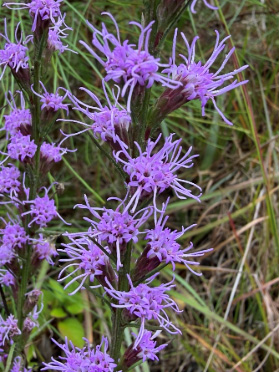
Intricate flower heads; photo: Betsy Washington
As the common name suggests, the leaves are long and linear, almost grass-like and can reach up to 8 – 12” long at the base, arching from an underground corm and gradually decreasing in length as they ascend the stem until they are almost needle-like and only 2 – 3” long. The leaf margins have a fine fringe of hairs that give a shaggy appearance giving rise to another common name.
The nectar-rich flowers make this, like other Liatris species, a highly sought after pollinator plant as noted above. Songbirds such as goldfinches and sparrows feed on the protein-rich seeds in fall and winter. Indigenous people used decoctions from the corms and roots to treat sore throats, kidney issues, and inflammation. Further, chemical compounds have been made from the roots and leaves for use as blood thinners and as an insect repellent.
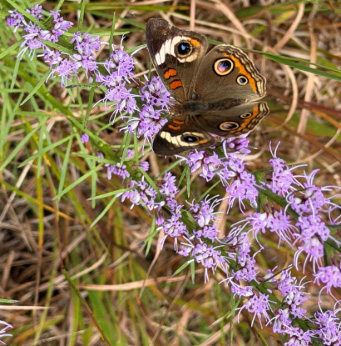
Pollinators like this Common Buckeye flock to Liatris pilosa; photo: Betsy Washington
Grass-leaved Blazing Star is remarkably resilient, drought tolerant, deer resistant and at home on poor sandy or gravelly soils allowing these lovely wildflowers to grow in inhospitable sites where other plants would languish; however they do not tolerate poorly drained soil. They prefer full to partly sunny sites.
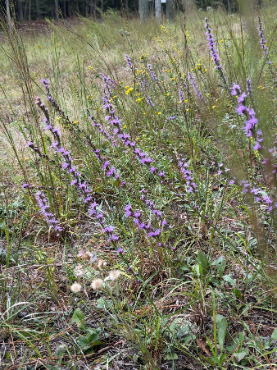
Liatris with floral display along roadsides; photo: Betsy Washington
The Flora of Virginia describes Grass-leaved as frequent to locally common in the Coastal Plain, but it is always a surprise and delight to notice the dramatic wand-like purple spikes rising among the equally lovely clumps of Split-beard Bluestem along the back roads of the Northern Neck. Other wildflowers such as Maryland Golden-aster and Slender Goldenrod, as well as Wild Yellow Indigo and other drought tolerant beauties, also thrive in the same habitats. These resilient species found in roadside grassland/meadows hark back to a time when historic grasslands were once more abundant in the Coastal Plain and Piedmont when they were maintained by periodic fires. Nonetheless we are fortunate indeed that these elegant pinkish purple spikes turn open roadsides into veritable gardens, attracting butterflies, other pollinators, and native plant enthusiasts alike. Take a cruise down the back roads and check out these remnant grasslands and gorgeous native perennials.
Grass-leaved Blazing Star is the Northern Neck Native Plant Society October 2026 Plant of the Month.
