
Plantain-leaved Pussytoes, Antennaria plantaginifolia
By Betsy Washington, Northern Neck Native Plant Society
Plantain-leaved Pussytoes is one of our most charming perennial groundcovers and begins blooming this month with fuzzy white, tufted flower heads that resemble the toes or paws of kittens. Other names for this appealing groundcover are Pussytoes, Everlasting, Mouse Ears, Ladies’ Tobacco, and even Dog Toes. Who can resist such a colorfully-named flowering, adaptable groundcover? The flowers are borne at the tops of short woolly stems that reach 6 – 15 inches above a basal rosette of gray-green velvety leaves. The whole effect is irresistible.
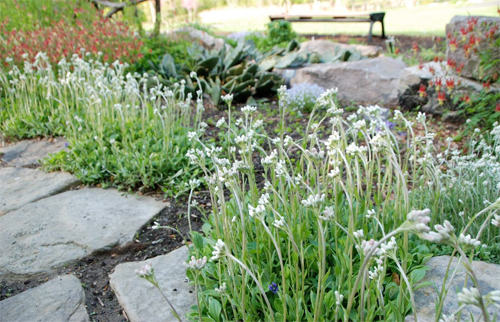
Pussytoes forms a lovely groundcover combined with wild columbine in this garden; photo: Betsy Washington
In mid to late March, tight clusters of 3 – 30 flowers wave above the semi-evergreen leaves. Individual plants are dioecious, meaning that they have either female or male flowers. Female flowers have numerous thread-like fluffy white styles at the top while the males have brown stamens that protrude from the center of each flower, leading to the Latin name Antennaria referring to their supposed resemblance to the antennae of butterflies (more charm!). They bloom for several weeks from March to May, supporting a myriad of bees and pollinators. After flowering, seeds are held in achenes (covering of a single seed) with short white hairs that aid in wind-blown seed dispersal, as in many Aster family relatives and the flowering stems die back leaving a low, handsome groundcover.
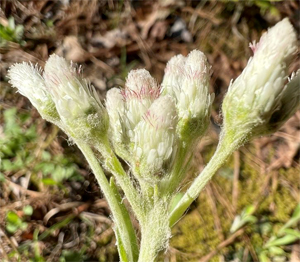
Detail of flower head; photo: Anne Parker
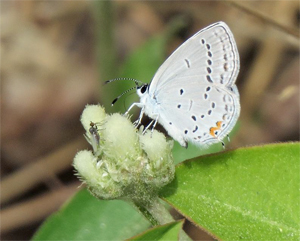
Eastern Tailed-blue nectaring on Pussytoes; photo: Betsy Washington
The specific epithet (second part of the botanical name) refers to the resemblance of the basal leaves to those of plantains. Each basal leaf is spoon or spatula shaped with 3 – 5 conspicuous veins and is densely white woolly underneath. Much smaller, narrow leaves alternate up the flowering stem. The whole effect is quite handsome with soft gray green velvety foliage that blends well in any garden. The leaves are semi-evergreen but in our area typically persist through the winter becoming a bit tattered and discolored.
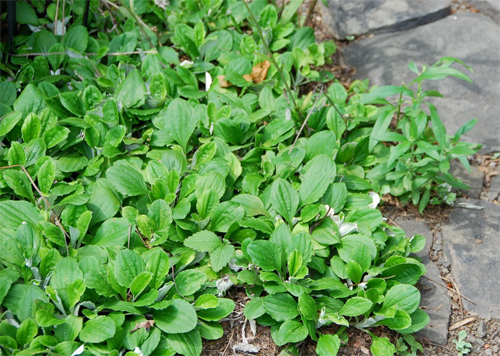
Pussytoes form a dense, weed-smothering groundcover along this hot, dry path; photo: Betsy Washington
Pussytoes are made for tough sites, thriving in lean, dry soils across much of the eastern North America from Nova Scotia west to Montana south to Georgia and Texas. In Virginia, Pussytoes occur in nearly all counties in dry woods, thickets, along roadsides and on banks in lean soils in both sun and part shade. The Flora of Virginia indicates it, “is probably common throughout” but taxonomy is confused and specimens have been lumped with similar species (such as the similar and garden-worthy A. parlinii) creating confusion about exact distribution. However, there is no confusion about how wonderful Pussytoes are in the garden. They spread both by seed and vegetatively by stolons (trailing stems) that root and form new plants wherever they touch the ground. The foliage is allelopathic, meaning that Pussytoes release chemicals that deter other plants from germinating nearby, adding to their ability to form a weed-smothering groundcover. Pussytoes are perfect for any well drained, dry, sandy or rocky acidic soils, on slopes, rocky ledges or along open woodland edges. Their handsome mat-forming habit makes them a low excellent groundcover, for massing along the front of a border, on slopes, beneath shrubs, or between stepping stones, or in dry meadows. They mix well with other clump-forming plants and groundcovers such as low goldenrods, low native grasses such as Purple Lovegrass, Poverty Oatgrass or Little Bluestem, and are effective at preventing erosion especially in shady sites. They have even been used effectively on green roofs! However, they do not like to be crowded by larger companions. They are highly resistant to deer or other herbivores and have no serious pest or disease problems as long as they are planted in well drained, lean soils. Another lovely member of the genus, Single-headed Pussytoes, Antennaria solitaria, occurs in Lancaster County in calcium-rich soils near Cabin Swamp in Hickory Hollow and on bluffs or streambanks and as you might guess it has a larger, solitary flower head, but is equally as charming and also a great groundcover. This species begins blooming in early March.
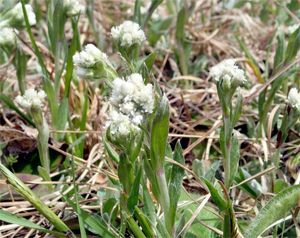
Pussytoes form the ground layer in this meadow at Mt. Cuba Center; photo: Betsy Washington
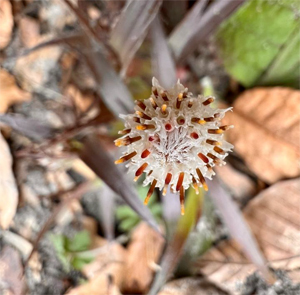
Single-headed Pussytoes has a distinctive single flower head; photo: Betsy Washington
Not only are Pussytoes a tough adaptable groundcover with handsome good looks, they support an amazing variety of native bees including, early bumblebees, mining bees, several types of sweat bees including the beautiful metallic green sweat bee, as well as butterflies and a host of night-flying moths. In fact they are one of the main host plants for our beautiful American Lady butterflies, reason enough to grow them! The seeds are eaten by songbirds, bobwhites, and small mammals.
Surely there is a place or two or more for charming Pussytoes in your own landscape!
American Hazelnut is the Northern Neck Native Plant Society March 2026 Plant of the Month.
