
Flat-branched Tree-clubmoss, Dendrolycopododium obscurum
By Betsy Washington, Northern Neck Native Plant Society
Common Tree-clubmoss—often called Princess Pine, Common Ground-pine, or Flat-branched Tree-clubmoss—is appropriately named, as each plant looks like a miniature pine tree and a colony resembles a miniature forest. Club mosses are ancient plants and evolved over 400 million years ago and reproduce by spores produced in “club-like” structures. Some 300 million years ago, before the age of dinosaurs, primitive clubmosses formed huge swamp “forests” reaching up to 50’ tall forming much of the coal deposits we extract for fuel. Today they are mere shadows of their ancestors but are still highly successful plants with over 400 species worldwide; extant species all form low evergreen groundcovers less than a foot tall.
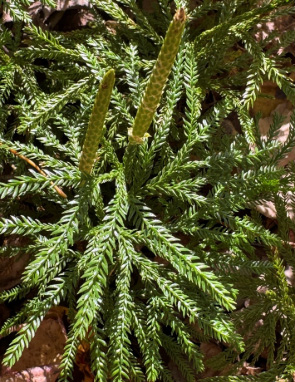
Details of needle-like, evergreen foliage and club-like spore-producing ‘cones’ at top of foliage; photo: Betsy Washington
Princess Pine, like other clubmosses, has long creeping stems that run just under the surface of the soil (rhizomes) branching freely and spreading outwards to form extensive colonies. Every few inches to a foot, upright erect aerial stems arise like miniature pines, seldom reaching more than 6” high. Whorls of flat horizontal branches resemble the limbs of a tiny conifer tree and give the species another of its long common names, Common Flat-branched Tree-clubmoss. These branchlets are covered with six rows of tiny, shiny needle-like evergreen leaves – one on top, two lateral needles on either side and a very short one at the bottom. This heightens the flattened appearance of the branches and is a distinctive characteristic for this species.
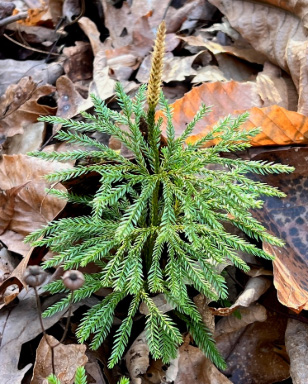
Photo: Betsy Washington
Although Princess Pine spreads widely by rhizomes, it also produces spores through reproductive structures called sporangia. These upright yellowish “club”-like sporangia form directly at the clubmoss top in late summer-early fall. These clubs are spore “factories” producing tiny, oily, golden spores that are dispersed by winter winds or wandering wildlife. If these tiny spores are fortunate enough to fall on suitably moist soil or leaf litter with the right fungus, they may begin a rather complex alternate life cycle. Hidden from us, they reside underground and cannot photosynthesize but are completely dependent on a symbiotic mycorrhizal fungus to provide all of their nutrients. Although research is limited, it is estimated this underground stage can last as long as 8 to 20 years. This stage eventually reproduces sexually underground and the above ground life cycle begins anew. All stages of clubmosses appear to be dependent on mycorrhizal fungal partners, at least in part.
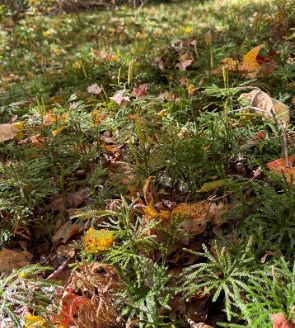
Princess Pine spreads by rhizomes into colonies; photo: Betsy Washington
Common Tree-clubmoss or Princess Pine is found throughout eastern North America from Nova Scotia and Quebec south to Virginia and extending in the mountains south to Georgia. It is found in every county in Virginia and is an indicator of very moist, poor, strongly acidic soil that is low in nitrogen. Princess Pine can tolerate more sun and occasional dry forests in cooler northern latitudes and high elevations but in our area, we find it most often in damp acidic forests flatwoods, and swamp hummocks.
The oily spores are highly flammable and have long been used by humans to create small flashes of fire for early flash photography, magic tricks and other special effects. They have antifungal properties and have been used to treat wounds and produce antifungal agents. They are highly hydrophobic (repelling water) which makes them useful for coating pills and surgical gloves, among other uses. In fact, you can still buy clubmoss spores today—called Lycopodium powder or Dragon’s Breath!
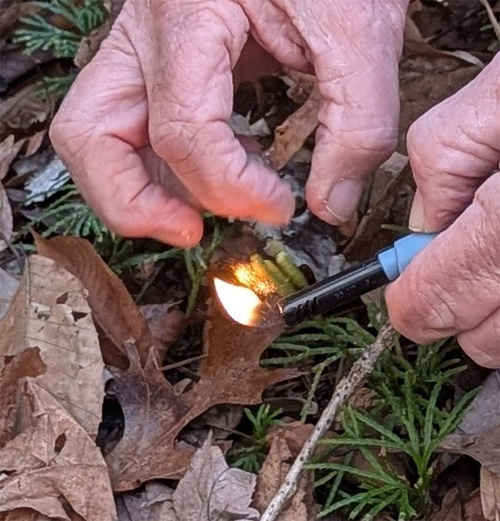
Tiny oily spores readily ignite in a flash of fire; photo: Betsy Washington
Clubmosses were once collected in great quantities (and still may be) by pulling the long trailing rhizomes up in great ropes. One study estimated that over 170,000 lbs. of this species was harvested per year for holiday decorations and for their medicinal properties. Because of the unique alternating life cycle, incredibly slow growth, and dependence on mycorrhizal fungi, this practice can quickly decimate large populations of these ancient plants. As you might guess, they are nearly impossible to propagate or transplant, nor are they available in nurseries. This is not a plant for your garden unless you are lucky enough to have them growing naturally. Instead enjoy this beautiful evergreen groundcover where it grows in nature and admire the sparkle and color it adds each winter to our forests.
Clubmosses are green all year and easily seen on winter walks.
Flat-branched Tree-clubmoss is the Northern Neck Native Plant Society December 2025 Plant of the Month.
