
American Hornbeam, Carpinus caroliniana
By Betsy Washington, Northern Neck Native Plant Society
As lingering fall leaves drop in November, the bark and architecture of American Hornbeam, the November Plant of the Month, take center stage showcasing its winter beauty. American Hornbeam is particularly elegant at this time of year. It is known by many common names including Ironwood, American Hornbeam, Blue Beech, Musclewood, and Water-beech all referring to the beautiful, smooth, gray bark and elegant, fluted trunks. Each common name offers a glimpse into the “personality” of this charming tree. Its smooth gray bark and thin, pointed oval leaves are superficially reminiscent of our magnificent American Beech but in a much smaller package. But appearances can be deceiving. Ironwood is actually a member of the Birch family sharing several distinctive characteristics such as cylindrical flowers held in catkins, fine, doubly toothed leaves that provide light dappled shade and ornamental bark. The names Ironwood and Hornbeam refer to the close-grained, extremely hard and heavy wood that takes on a horn-like polish and has been used to make tool handles, wedges, bowls, and mallets.
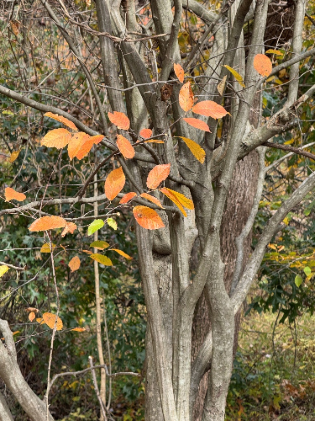
Vivid fall color stands out against smooth bark; photo: Betsy Washington
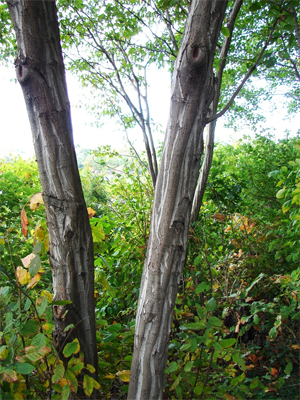
Beautiful fluted, muscley bark; photo: Betsy Washington
This small understory tree is lovely in every season but is particularly striking in fall and winter as the leaves fall and its sinuous smooth gray trunk catches the eye. Averaging 20 – 35’ tall and wide, American Hornbeam is often multi-trunked with distinctively fluted stems featuring smooth gray bark that ripples and twists over long sinewy ridges like flexed muscles, giving rise to another of its common names, Musclewood. The distinctive trunks are often somewhat short and crooked or leaning but spread out into a broad graceful canopy with a fine pattern of branches creating an elegant appearance.
Ironwoods are monoecious meaning they have separate male and female flowers on the same tree. As noted above, the flowers are held in dangling chain-like catkins (petal-less flowers arranged along a central stem) with green scales edged in red, adding subtle texture and color to the emerging foliage which itself is often tinged red. The female flowers ripen into small ribbed nutlets, each subtended with a leafy three-lobed bract beneath, dangling in clusters. In summer the thin doubly serrate leaves are a handsome green, are seldom bothered by pests and add a light touch to the landscape. In fall they ignite in fiery shades of yellow, orange and vivid red, especially when exposed to sun.
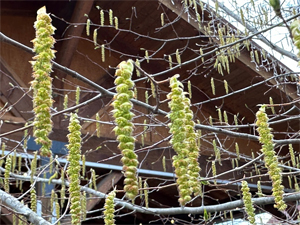
Spring flowers are held in drooping catkins; photo: Betsy Washington
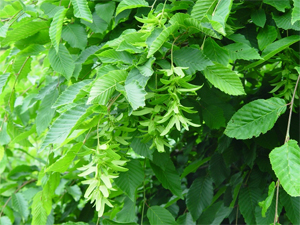
Nutlets with 3-lobed leafy bracts provide food for wildlife; photo: Betsy Washington
This slow-growing deciduous tree is a common understory tree occurring mainly in moist to seasonally wet floodplains, along stream or riverbanks and edges of swamps, and in mixed hardwood forests. It is quite adaptable and tough enough to colonize moist old fields and woodland edges in full sun. It has a huge geographic range essentially extending throughout eastern North America from Ontario and Quebec south to northern Florida and Texas and into the mountains of Mexico and Central America. In Virginia, Ironwood is common in the Coastal Plain and Piedmont and frequent in the Mountains but usually at lower elevations.
As you might guess, any plant with such a large geographic range is quite adaptable and can tolerate a wide variety of growing conditions. Best growth occurs on rich, moist soil in part shade, but this tree tolerates full shade, seasonal or occasional flooding, and full sun in moist sites. It also tolerates both clay and sandy soils, deer browse and even the allelopathic Black Walnut (allelopathic refers to the ability of a plant to release a toxic chemical from their roots, leaves, and hulls which can inhibit the growth of nearby plants). While strong, dense wood protects it from storm and wind damage, it does not tolerate prolonged drought. Ironwood has a reputation for being difficult to transplant and may be best planted from containers as a small tree in spring; however, several respected horticulturists have no issues transplanting even large field grown specimens if dug with a wide, shallow root ball.
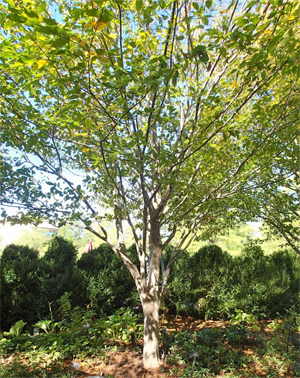
Ironwood is often multi-trunked with an airy crown; photo: Betsy Washington
Ironwood is the perfect small tree to plant in shady gardens, along woodland edges, or along streams or riverbanks where its fibrous, spreading roots help stabilize the soil. It is also striking enough to be used as a specimen tree or in formal landscapes. Ironwood can be sheared into hedges as in the famous formal ellipse garden at Washington, D.C.’s Dumbarton Oaks, or espaliered against a wall or planted as a formal allée as in the U.S. Botanic Garden. In the mid-Atlantic and South, Ironwoods are often found growing with American Beautyberry, Virginia Sweetspire, Southern Wax Myrtle, Mapleleaf Viburnum and Winterberry and these make splendid garden companions.
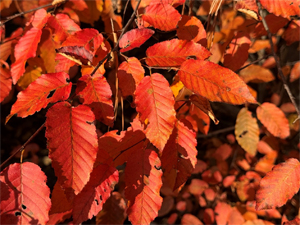
Fiery fall color ignites the fall landscape along a sunny woodland edge; photo: Betsy Washington
This lovely tree is not only an elegant, low-maintenance landscape choice, but it supports an abundance of wildlife. The seeds, buds, and catkins are eaten by a wide variety of song and gamebirds and small mammals including Bobwhite, Wild Turkeys, Ruffed Grouse, Wood Ducks. Thrushes and Chickadees. It also provides important nesting habitat and shelter for a variety of wildlife making it a wonderful addition to a wildlife or natural garden. Ironwood is also the larval host plant for several butterfly species including the Eastern Tiger Swallowtail and the Red-spotted Purple, earning it a place in a butterfly, pollinator or children’s garden. No matter how you use this distinctive tree, it is sure to be a highlight in your garden throughout the year.
[One of my favorite trees, too. Easy to learn, easy to teach.—Ed.]
American Hornbeam is the Northern Neck Native Plant Society November 2025 Plant of the Month.

I have 2 Hornbeams near woods-edge adjacent to an ephemeral stream that passes through the bottom of my back yard. I planted them spring 2024. They are ~6′ tall. They seem to thrive. I have wire-mesh cages around them for another couple years, for deer-browse is rapacious in this neighborhood (just outside Warrenton).
They are an incidental part of my eco-system restoration project, now (autumn 2025) finishing its 3rd growing season. I’m removing a baker’s dozen exotic invasive species, planting native trees, shrubs, vines. I’m standing up a food forest for birds (both migratory & resident) and small mammals. To date I have
* 12 premier lepidoptera host species
* 21 berry/nut/fruit producer species
and consider the initial property transformation to be ~half complete. Douglas Tallamy’s work informs my efforts – as do the local Master Gardener community and a small, intense group of Master Naturalists.
Besides the woods recovery, I have a specimen orchard of domestic fruit
* apples (I had to fell 10 mature Eastern Red Cedars, after finding a CAR fruiting body on one)
* European pears
* Japanese plums
* peach
each with a guild around it – now undergoing enlargement
I have ambitions to grow a vegetable garden, but the ecosystem-recovery effort has taken all my time during the 2024 & 2025 season. I have pulled & burned (no herbicide use – I’m at headwaters of a drainage that eventually empties into the Chesapeake – runoff would poison a LOT of people downstream from me) 4 1/2 dump trucks worth of brush and vines, one wheelbarrow at a time. The labor has occasionally verged on brutal.
The soil here is red clay – extremely fertile, pH 5.5 (the blueberries think they’ve died and gone to heaven). I bring in curbside leaves by the truckload each autumn, for mulch. Earthworms (or something…) eats it away from below, and the soil turns black. Nature appears to accept grudgingly my offered partnership.