News & Updates
- A Perpetual Journal Practice Workshop with Lara Call Gastinger
Tuesday, October 20 at 10AM
Ivy Creek Natural Area
Spots are limited, email rcarter112@aol.com to register. - Night Shift: Plants that Support Nocturnal Wildlife
Natalie Izlar from Virginia Working Landscapes shares native night-blooming plants, species whose foliage and flowers glow in the moonlight, and the diverse habitats that sustain nocturnal wildlife. - Wildflower Walks at Ivy Creek
The third Saturday of every month, meet at the parking lot kiosk at 9AM. Check Upcoming Events for more information. - Fire Ecology in the Southeastern US
Marie Norwood, a PhD Student in Dr. Carla Staver's lab in the Princeton Department of Ecology and Evolutionary Biology, shared ways that fire shapes, and is shaped by, vegetation, climate, and land management. - Methods for Ecological Restoration at Home
Piedmont Discovery Center team shares hands-on ecological restoration methodologies. - Corpse Botany
Virginia Working Landscapes’ Botany Technician, Natalie Izlar, helps us identify dormant plants. - The Basics of Nature Journaling(opens in new tab)
Carolyn Duckworth shares the basics of nature journaling for both personal enjoyment and programming and education opportunities. - Calculating the Impact of Leaving Leaves(opens in new tab)
Interesting article on the current science regarding leaving fallen leaves on your lawn and garden. -
Check out this great new resource from Virginia Working Landscapes.
- Find more chapter meeting videos at our showcase(opens in new tab).
- Update your calendar for upcoming local meetings, presentations, lectures, and other events described in the Jefferson Chapter Events Calendar(opens in new tab).
- And keep up with Jefferson chapter activities and discussion on our Facebook Page(opens in new tab)!
Join
Become a Member:
Support Our Mission.
Donate
Support VNPS with
your donation today.
Upcoming Events
Find Field Trips, Meetings, Programs and Plant Sales.
Find a Chapter
Get involved in your
local VNPS chapter.
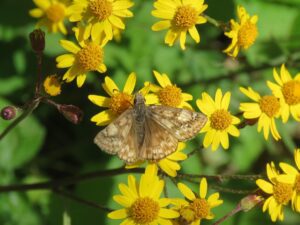
Plant Sale 2025 — Packera aurea
Packera aurea (Golden Ragwort) makes a very nice groundcover. The flowers look like deep yellow daisies and are in bloom for about three weeks. Not only is this plant beautiful, herbivores rarely eat it because it is toxic. While happiest in moist to wet soils in either sunny or shady…
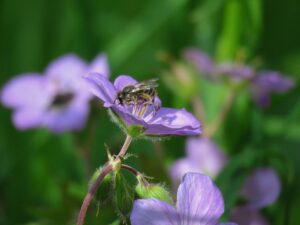
Plant Sale 2025 — Geranium maculatum
Geranium maculatum (Wild Geranium or Wild Cranesbill) is a great plant to add to gardens: It reaches from ½ – 2 feet in height It grows in part shade such as dappled shade under trees The white, pink or more often purple blooms appear between April and June The palmate…
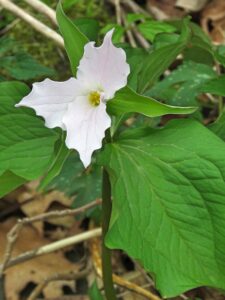
Plant Sale 2025 — Trillium grandiflorum
Trillium grandiflorum is known as both large-flowered trillium (the flower spans 3-4” across) or great white trillium. It is one of the showiest trilliums in Virginia. It is a woodland plant commonly found in the mountains and enjoys dappled shade and rich soils. Each flower consists of 3 white petals,…
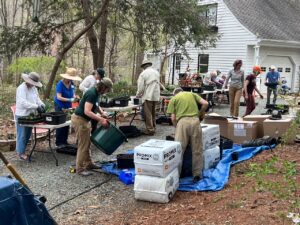
Potting Party Success!
On Sunday, March 30, William Hamersky graciously hosted the Potting Party at his Full Tilt Farm, to pot up member provided divisions of such sale favorites Celandine Poppy, Green and Gold, Robin’s Plantain, Golden Ragwort, Wild Petunia, and White Wood Aster. In the past, nearly half of the plants offered…