Your Yard Wants to be a Forest

Eupatorium at Bull Run

Eupatorium at Bull Run

Eupatorium at Bull Run

Photo by Brigitte Hartke

Photo by Brigitte Hartke

Photo by Brigitte Hartke

previous arrow
next arrow

News & Updates

Grant proposals for Clarke County projects are being accepted through 31 July 2026. 5 June 2026

If you are not receiving regular emails from us at VNPS Piedmont, please contact our Vice President Mitzi Fox at fox57va@gmail.com.  We send emails for each monthly Second Saturday Walk and for other events. To search for your emails from us, search "PiedmontVNPS@gmail.com" in all folders including spam. 5-9-2024

• Please join us in preserving Jocelyn Sladen’s legacy and in celebrating her life as a conservationist and a founder of VNPS. Donate now to help us save Torrey’s Mountain Mint. 4-4-2024

• View our newest brochure "Your Yard Wants to be a Forest". And see more information and resources for the brochure. For printed copies, send a stamped, self-addressed envelope to VNPS Piedmont Chapter, PO Box 336, The Plains, VA 20198. 4-5-2023

Join

Become a Member:
Support Our Mission.

Donate

Support VNPS with
your donation today.

Upcoming Events

Find Field Trips, Meetings, Programs and Plant Sales.

Find a Chapter

Get involved in your
local VNPS chapter.
By Betsy Washington, Northern Neck Native Plant Society Milkweeds are wildly popular in many gardens but most of us grow only two or three species, including Butterflyweed and Swamp Milkweed and possibly Common Milkweed. There are thirteen species of milkweed in Virginia and one of my favorites blooms in late May and June, Redring or…Read more
By Betsy Washington, Northern Neck Native Plant Society The cheerful flowers of our native Common Blue Violet are one of the most anticipated signs of spring, bringing joy to both gardeners and pollinators alike. Blooming from March to June, with occasional rebloom in fall, our Common Blue Violet reaches only 3 – 8” tall with…Read more
By Betsy Washington, Northern Neck Native Plant Society Plantain-leaved Pussytoes is one of our most charming perennial groundcovers and begins blooming this month with fuzzy white, tufted flower heads that resemble the toes or paws of kittens. Other names for this appealing groundcover are Pussytoes, Everlasting, Mouse Ears, Ladies’ Tobacco, and even Dog Toes. Who…Read more
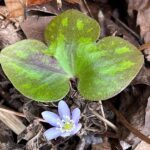
By Betsy Washington, Northern Neck Native Plant Society Chapter One of the earliest signs of spring is the bloom of the Round-lobed Hepatica or Liverleaf, Hepatica americana. The lovely small flowers of this woodland wildflower look fragile but this hardy perennial blooms in the face of winter often as early as February. An array of…Read more
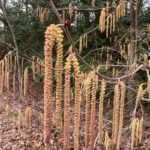
By Betsy Washington, Northern Neck Native Plant Society Our February Plant of the Month, American Hazelnut or Filbert, Corylus americana, is one of our earliest blooming native shrubs, a true harbinger of spring often flaunting its flowers as early as February. As a member of the Birch (Betulaceae) family, American Hazelnut is monoecious, meaning it…Read more
Coming soon: VNPS offers Ghost Pipes artwork on T-Shirts and other apparel. Visit our Online Store to order. Ghost Pipes are herbaceous perennial plants that lack chlorophyll; they obtain their nutrients via mycotrophy, i.e., by parasitizing the fungi present in their roots. The plants are commonly white at flowering but, in rare instances, may be…Read more
By Betsy Washington, Northern Neck Native Plant Society Ebony Spleenwort is a charming small, evergreen fern that grows in dense tufts with dark green narrow fronds with a distinctive, wiry dark reddish brown shiny main stem (stipe). In fact, it gets its common name, Ebony, from this very distinctive dark shiny stipe. The narrow fronds…Read more
By Betsy Washington, Northern Neck Native Plant Society Common Tree-clubmoss—often called Princess Pine, Common Ground-pine, or Flat-branched Tree-clubmoss—is appropriately named, as each plant looks like a miniature pine tree and a colony resembles a miniature forest. Club mosses are ancient plants and evolved over 400 million years ago and reproduce by spores produced in “club-like”…Read more