


In the latest Sempervirens







News & Updates
 The latest Sempervirens is here! 8 May 2026
Save the dates: the 2026 annual meeting will take place 2-4 October 2026, in Wakefield, Virginia. 3 April 2026
Winners of the fifth annual Wildflower of the Year T-shirt Design Contest have been announced. 27 March 2026
Video recordings of both sessions of the 2026 Annual Workshop are available in a Vimeo showcase. 27 March 2026
Thank you for supporting our 2025 fundraiser benefiting the Flora of Virginia. The campaign has ended. If you would like to support the Flora, please donate directly. 3 March 2026
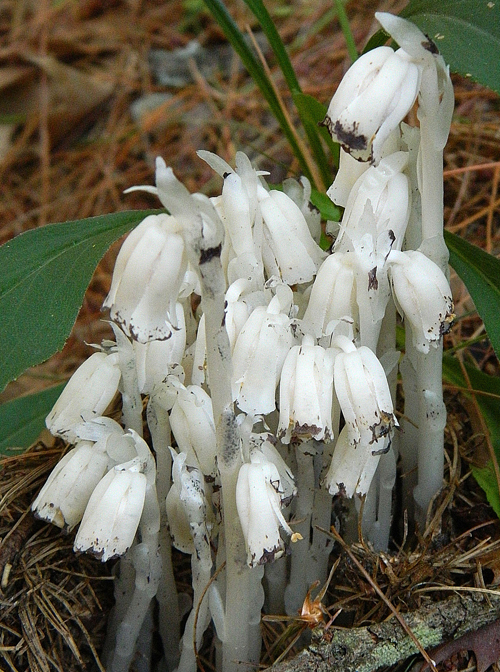
Introducing the 2026 Wildflower of the Year, Ghost Pipes (Monotropa uniflora). Read all about it. 25 January 2026
Now with its own menu pick: Botanizing with Marion. 20 June 2025
• A New Online Dictionary of Virginia Botanical Etymology. This dictionary, compiled and edited by Michael Charters, lists Latin, Greek, and other derivations of botanical and biographic names in Virginia. View the Online Dictionary here. 20 August 2024
Join
Become a Member:
Support Our Mission.
Donate
Support VNPS with
your donation today.
Upcoming Events
Find Field Trips, Meetings, Programs and Plant Sales.
Find a Chapter
Get involved in your
local VNPS chapter.

Wax Myrtle Sparkles in Winter
By Betsy Washington, Northern Neck Chapter Our evergreen Wax Myrtle or Southern Bayberry (Myrica cerifera) is handsome in every season of the year but it particularly sparkles in the winter after the leaves of deciduous trees have fallen leaving a gray and brown landscape. Not only are Wax Myrtles a beautiful native evergreen (large shrub…

Blue-Stemmed Goldenrod Lights Up Woodlands
By Betsy Washington, Northern Neck Chapter At our recent fall native plant sale a number of shoppers requested shade tolerant perennials that bloom in shady woodland gardens in late summer and fall, long after spring bloomers have faded. The October Plant of the Month, Blue-stemmed Goldenrod, Solidago caesia, fits the bill beautifully and like other…

Enchanting Blue Vervain
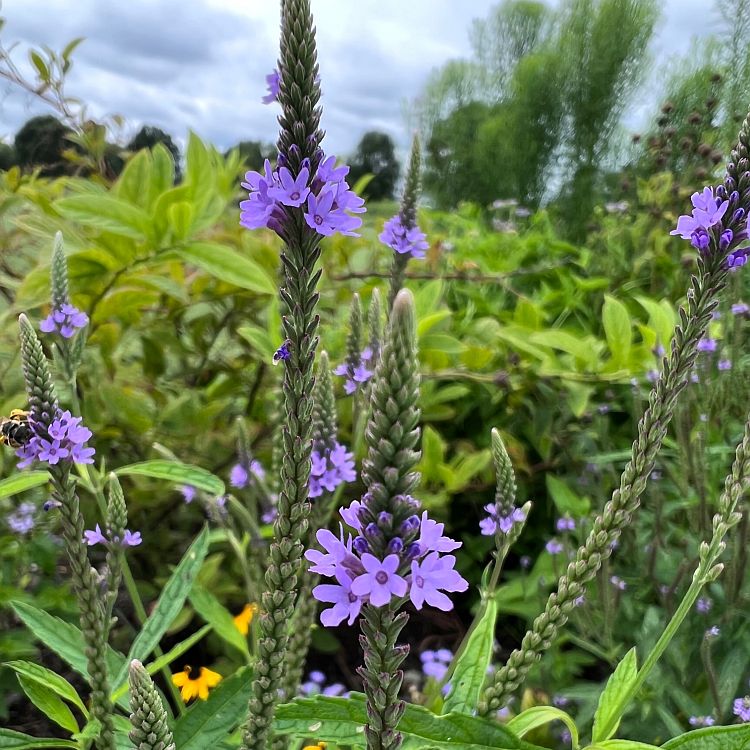
By Betsy Washington, Northern Neck Chapter Blue Vervain (Verbena hastata) enhances any landscape in which it grows. It is one of my favorite mid to late summer native perennials for any number of reasons. The beautiful purplish blue flowers atop tall stems provide a striking vertical accent contrasting with more typical mounded plants and flower…

Turk’s-Cap Lily Stuns in Summer
By Betsy Washington, Northern Neck Chapter Turk’s-cap Lily (Lilium superbum) is one of our most spectacular wildflowers in eastern North America. Its stunning flowers bloom right now in July and August. Native to wet meadows and rich moist cove forests and bogs from New Hampshire south to Georgia and Alabama, it is found in most…

The Curious Pawpaw
By Betsy Washington, Northern Neck Chapter The Pawpaw, Asimina triloba, is a handsome small tree that is as fascinating as it is curious. Pawpaw is a member of the Custard-Apple Family, the Annonaceae, a large family of tropical and subtropical species. Ranging from Florida and Texas north to New York and Southern Ontario, Pawpaw is…

The Spicebush Swallowtail Butterfly, Its Host Plants, and the New Threat They Face
By Mary Lee Epps A new non-native fungus and the beetle that carries it may soon severely impact sassafras, spicebush, and most other members of the Laurel family in the United States. Sadly, since these are the main host plants of the spicebush swallowtail butterfly, which is now common throughout most of the Eastern U.S.,…

Magical Mexican Dogwoods: What Should We Call Them?
By W. John Hayden, Botany Chair Who knew? Cornus florida, the 2018 VNPS Wildflower of the Year and State Tree of Virginia, has a cousin living in the mountains of eastern Mexico! Mexican Dogwoods have been found in the states of Nuevo Leon, Tamaulipas, and Veracruz. They are, manifestly, close relatives of the familiar Flowering…

Partridge-berry Is Bright All Year
By Betsy Washington, Northern Neck Chapter Partridge-berry (Mitchella repens) is a handsome evergreen vine that creeps along the ground reaching only 2” high. Its long trailing stems can reach 12” long but it develops roots at nodes along the stem wherever it touches the ground, creating large dense colonies. Widespread across eastern North America, it…

Native and Invasive Plant Legislation in the 2022 General Assembly
The Virginia General Assembly convened January 12, 2022 and three bills were introduced in the House of Delegates that deal with native and invasive plants. The first step is to assign the bills to committees, then to subcommittees. Bills must pass the committee to be referred to the House for a full vote. View the Virginia…

Wildflower of the Year 2022 Buttonbush (Cephalanthus occidentalis)
Buttonbush is a shrub or small tree commonly attaining heights up to about 6 m, occasionally twice that size. Leaves are opposite or whorled, elliptic to ovate, 2-8 cm wide, and 6-15 cm long; margins are entire and apices are acute or cuspidate, i.e., with an abrupt, short, tooth-like point. Triangular stipules, 2-3 mm long,…

Baldcypress: Towering Virginia Icon
By Betsy Washington, Northern Neck Chapter Baldcypress, Taxodium distichum, our November Plant of the Month, is an unforgettable sight all year. But in late fall when its soft foliage turns vibrant shades of copper-orange, it lights up the entire landscape. These trees are called “bald” because, unlike most other conifers, they are deciduous and lose…
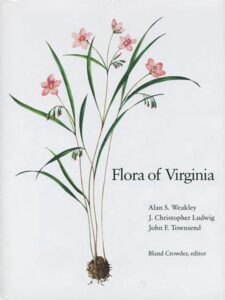
My Journey With the Flora of Virginia
By Marion Lobstein My interest in plants goes back to my childhood exploring and earning Girl Scout nature badges. As an undergraduate at Western Carolina University in the 1960s, I took my first plant identification class and really got hooked. Later, At UNC-Chapel Hill, I had the opportunity to take a plant taxonomy class with…